

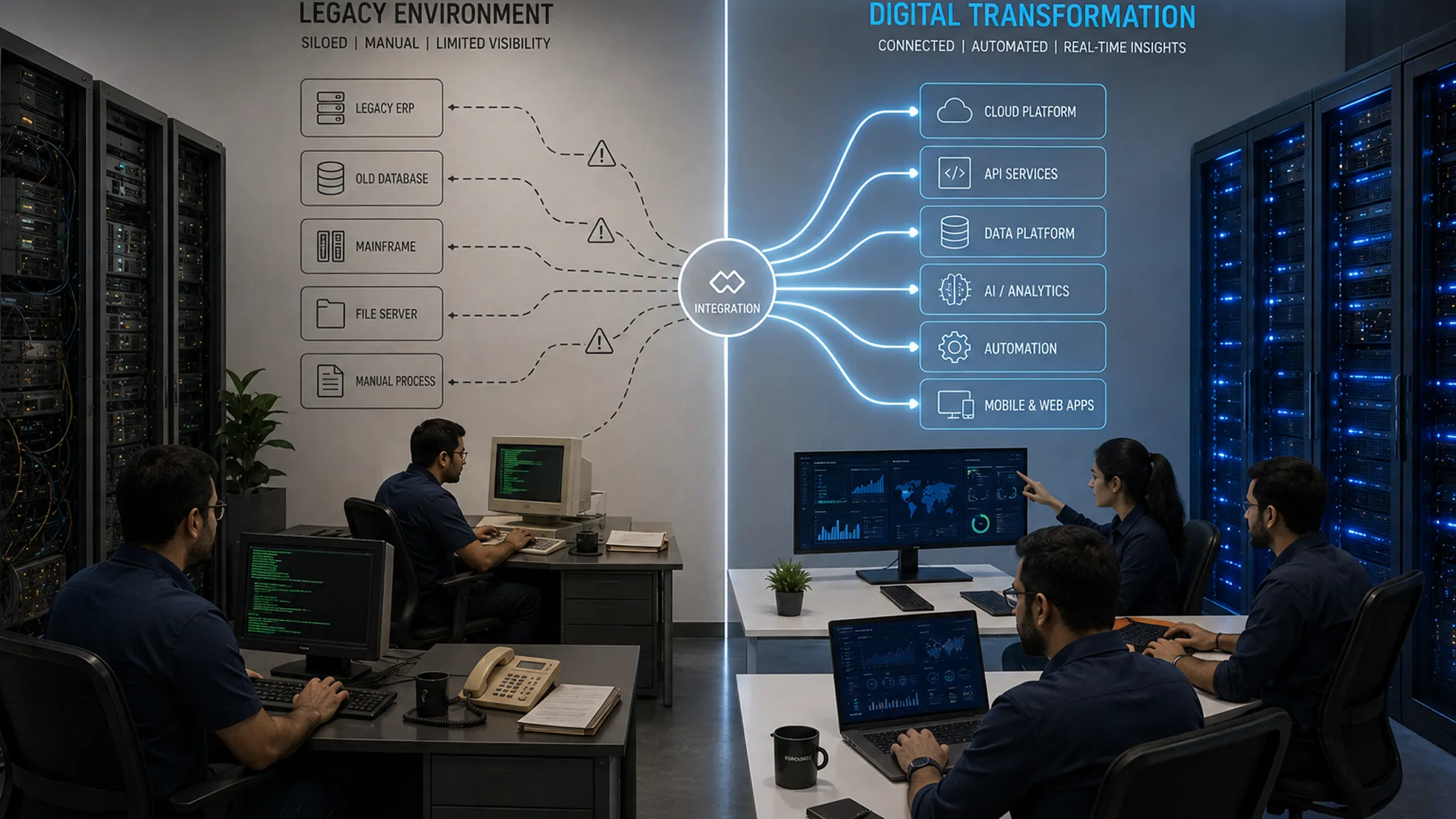
The UAE is following a very proactive digital economy policy. The Digital Economy Strategy of the UAE, for example, is forecast to increase the share of the digital economy in GDP from 9.7 percent in 2022 to 19.4 percent in the next decade. For firms, the problem is that merely using cloud computing, artificial intelligence, automation, or digital distribution channels is not enough. It’s rather about connecting those tools to existing applications, fragmented information, third-party ecosystems, and growing security concerns without compromising business continuity.
Why Digital Adoption Does Not Equal Enterprise Transformation
Implementing a new platform does not automatically create Business Digital Transformation . A mobile application or AI service may still depend on an ERP, CRM, finance platform, or legacy database that cannot exchange information reliably.
A connected enterprise architecture typically links digital channels to identity services, an API gateway, integration services, core applications, and a governed data platform.
| Transformation Requirement | Common Constraint | Technical Response |
|---|---|---|
| Connected Digital Channels | Point-to-point integrations | API-led integration |
| Real-Time Intelligence | Fragmented, batch-based data | Governed pipelines and event streaming |
| Cloud Scalability | Tightly coupled applications | Replatforming or re-architecting |
| Secure Data Exchange | Excessive privileges | IAM, API security, and Zero Trust |
| Automated Operations | Inefficient workflows | Process redesign and orchestration |
When these layers remain disconnected, UAE businesses can create additional digital silos instead of building an integrated operating model, an increasingly significant challenge as organisations modernize customer channels and business operations simultaneously.
The Technical Challenges Behind Modernization
Legacy Systems and Integration Debt
For UAE businesses modernizing rapidly while continuing to rely on established enterprise platforms, legacy systems are not automatically obsolete. They may still contain critical business logic and support essential operations. The challenge arises when these systems contain unsupported components, undocumented dependencies, or tightly coupled and point-to-point integrations that restrict change.
Therefore,
The legacy system may be partially exposed using an API façade without rewriting the whole system. The Strangler Fig pattern then enables selected functionality to be incrementally replaced with modern services.
Data Silos Limit AI and Decision-Making
An organisation might have huge amounts of data but be unable to extract any actionable intelligence out of it. Integration transfers data among different systems; interoperability makes sure that different systems have a similar understanding of the data; while governance defines ownership, quality, accessibility and life cycle management of the data.
For organisations in the UAE, when they implement their digital innovation programmes or enterprise AI solutions, some of the challenges that come up with respect to data include data duplication, inconsistent identities, differences in schema, batch processes, and difficult reconciliation.
Therefore, a data architecture of today may incorporate the use of ETL/ELT, data warehouse/data lakehouse, master data management, data cataloging, event streaming, and a common data model.
Cloud and APIs Expand the Security Surface
Cloud adoption and system interconnectivity increase the number of identities, permissions, APIs, data flows, and third-party dependencies that organisations must secure. As UAE businesses connect cloud-based systems with internal applications and external services, the security perimeter extends beyond the traditional enterprise network. .
In Enterprise Digital Transformation, therefore, the security architecture needs to cover the entire technology stack. IAM manages access, authentication verifies identities, authorization determines permitted actions, API security protects system-to-system communication, encryption protects data, secrets management safeguards credentials, and network segmentation limits the impact of a compromised component
For UAE businesses handling personal data, the UAE Personal Data Protection Law (Federal Decree-Law No. 45 of 2021) adds requirements around personal-data processing, protection, and governance. Organisations operating in specific sectors or jurisdictions may also need to comply with additional cybersecurity frameworks, including applicable Dubai Electronic Security Center requirements. For businesses operating across cloud and interconnected environments, security should therefore be addressed during the design phase rather than treated as an afterthought.
Automation Requires Process Redesign
Process Automation Technology will not help if there is a flawed process design. RPA automates repetitive interface interactions, APIs connect applications, workflow orchestration coordinates multi-step processes, and process mining reveals how processes actually operate.
The proper flow is:
Without following such a flow, organizations would simply automate their ineffective processes. The reason is to improve cycle time, accuracy, transparency, and Operational Efficiency.
From Digital Pilots to Production-Scale Architecture
A proof of concept need not necessarily be production-ready. It may leverage manually curated data, a small number of users, and controlled environments. For an enterprise implementation, there is a need for data pipeline robustness, API stability, access control, monitoring, error handling, governance, cost optimization, and integration with core applications.
It is here that Transformation Solutions need to be assessed within the context of an overall operating architecture and not merely as isolated technology solutions. The hard part is the transition from Proof of Concept to Production to Enterprise implementation.
The CEO insights from PwC’s UAE show that limited access to data across the enterprise is a key limitation to realizing the potential of AI in organizations.
Building a Practical Modernization Roadmap
For UAE businesses operating in a rapidly evolving digital economy, a Digital Transformation Strategy should begin with an assessment of the existing architecture rather than a wish list of technologies. The organization should assess applications, dependencies, data flow, integrations, vulnerabilities, and technical debt, among other things.
These areas can be prioritized based on business criticality, operational risk, dependency of integration, vulnerability, cost, and value.
Phase-based delivery would enable organizations to modernize selected capabilities without having to change everything at once. It will allow architectural choices to be tried and modified as required.
How Forchunex Supports Digital Transformation
Forchunex helps UAE businesses modernize complex technology environments through application modernization, system integration, data connectivity, workflow automation, and digital platforms. By connecting existing systems with new digital capabilities, Forchunex helps businesses build more integrated, secure, and scalable technology ecosystems.
Frequently Asked Questions
-
1. What is the greatest digital transformation obstacle for UAE
companies?
One major obstacle is the fragmentation of architecture. The company may have modern digital touchpoints but will continue to rely on legacy apps, isolated data, and integrations that inhibit scalability, visibility, and secure data exchanges. -
2. How can UAE businesses update their legacy systems without interrupting
the business?
An incremental approach will help with that. The business can use API facades, replatforming, event-driven synchronizations, and the Strangler Fig pattern to modernize selected capabilities while ensuring the operation of key business functions. -
3. Why is data interoperability necessary for enterprise AI?
AI applications need access to trustworthy data. Incompatibility of schemas, inconsistency of identifiers, and isolated systems may hinder any initiative from experimental stages to implementation in a production environment. -
4. How should UAE businesses approach their transformation journey?
Businesses should first assess their architecture, capabilities, dependencies, data, and security requirements. They can then prioritize initiatives according to business value and risk before implementing modernization through incremental phases.