

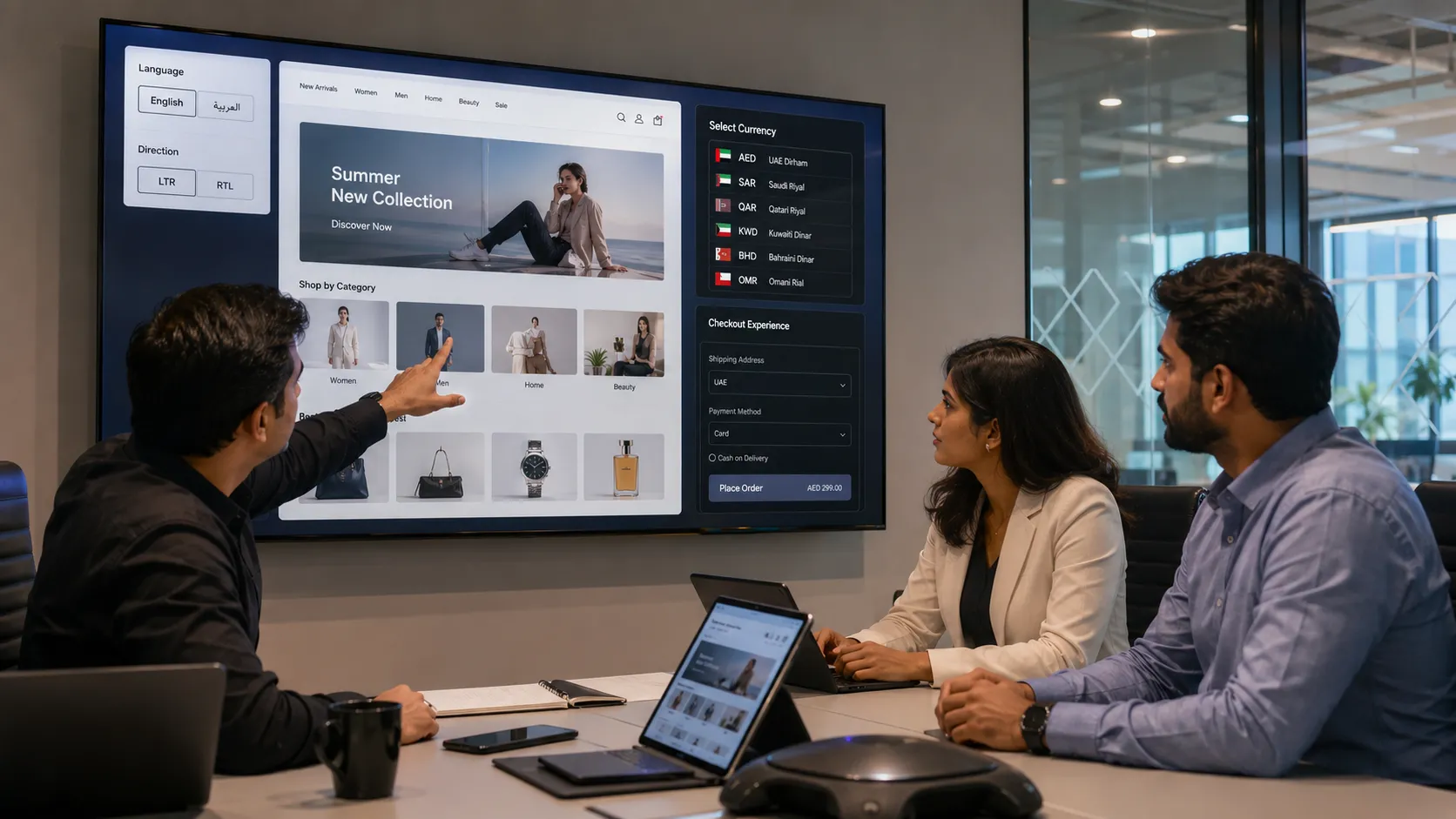
A technical guide to multilingual architecture, RTL engineering, regional pricing, payments, localization, SEO and enterprise integrations.
Introduction
Launching a website across the Gulf Cooperation Council (GCC) is often presented as a straightforward expansion exercise: translate the content, add local currencies, connect a payment gateway, and launch
Technically, that approach is incomplete.
A website serving the UAE, Saudi Arabia, Qatar, Kuwait, Bahrain, and Oman has to account for differences in language, currency, tax treatment, payment behaviour, address formats, product information, search intent, content structure, checkout logic, and regulatory requirements.
The complexity becomes even more visible when Arabic and English versions share the same commerce engine. Arabic is a right-to-left (RTL) script, while many product names, SKUs, numbers, prices, technical specifications, and brand names remain left-to-right. This creates bidirectional content requirements that cannot be solved reliably by simply flipping the page layout.
For a GCC expansion, localization therefore belongs in the architecture, not just the content workflow.
What Makes a GCC Website Different?
Consider a customer browsing an online store from Riyadh. They may expect Arabic or English content, prices in SAR, local payment methods, Saudi-specific delivery information, local address fields, applicable VAT presentation, a mobile-first checkout experience, locally relevant product availability, and appropriate invoicing.
Now consider the same customer experience in Dubai. The currency changes to AED. Tax logic changes. Payment preferences may change. Delivery rules can change. Address structures change. Content may require different localization.
The underlying website can remain one platform, but the commerce rules cannot simply be duplicated without a regional configuration model.
The key principle is simple: language, region and currency should be treated as structured application data rather than presentation-layer switches.
Multilingual Does Not Mean “Translate the Website”
A multilingual website GCC implementation begins with translation, but it cannot end there.
A translation layer asks how a sentence should be displayed in Arabic. A localization architecture asks what this customer should see, search, purchase, pay, receive and understand in this market.
That affects navigation, product descriptions, attributes, category names, filters, checkout labels, error messages, transactional emails, delivery information, return policies, terms, promotional banners, FAQs, metadata, structured data, image copy and customer support content.
The CMS therefore needs language-aware content models rather than a single field containing translated text.
Arabic Requires Real RTL Engineering
Arabic support is not simply direction: rtl. A production-grade GCC RTL website design needs to address the entire rendering system.
Arabic interfaces frequently contain mixed-direction content: Arabic text, Latin brand names, SKUs, numbers, prices, punctuation, URLs and email addresses. Developers need to test structural directionality, bidirectional text, form inputs, product identifiers, currency values, tables, breadcrumbs, carousels, filters and checkout components.
RTL is a rendering requirement, not a translation requirement.
Multi-Currency Is a Pricing Architecture Problem
A multi-currency website GCC needs more than a currency dropdown.
Currency affects product prices, discounts, promotions, tax calculations, shipping fees, payment authorization, refunds, invoices, reporting, accounting reconciliation and analytics.
A production commerce platform should distinguish between base currency, display currency and settlement currency. These do not necessarily have to be identical.
A centralized pricing service is preferable to performing conversions independently in the browser. The backend should remain authoritative for the final payable amount, with defined exchange-rate, rounding, promotion, tax, refund and reconciliation rules.
GCC Payment Integration Is More Than Adding a Gateway
Payment integration is one of the most important pieces of a regional commerce launch. A website may need cards, wallets, bank-based payment options, tokenized payment methods, 3-D Secure authentication, redirects, webhooks, refunds and partial refunds.
The payment layer should be abstracted from the storefront. The backend should verify transaction ID, payment status, amount, currency, merchant reference, signature, order ID and idempotency state.
A payment redirect should not be treated as the final source of truth. A reliable flow is checkout → authorization → gateway → webhook → payment verification → idempotency check → order confirmation.
Tax and Invoicing Belong in the Commerce Architecture
Regional expansion also means regional financial rules. Saudi Arabia's Zakat, Tax and Customs Authority (ZATCA) operates the FATOORAH electronic invoicing framework, with Phase 2 requiring applicable taxpayers' e-invoicing solutions to integrate with ZATCA systems according to the relevant requirements and rollout waves.
The exact implementation depends on the merchant's legal, tax and operational setup. The architectural principle is broader: tax and invoicing logic should be configurable backend services rather than frontend hard-coded rules.
Website Localization in the Middle East Goes Beyond Language
Website localization Middle East should consider the complete customer context.
Cultural localization includes imagery, representation, promotional language, campaigns, dates, numbers and units. Commerce localization includes currency, payment methods, tax presentation, shipping, returns and addresses. Search localization includes Arabic and English intent, localized terminology, metadata, URLs and hreflang. Operational localization includes CRM, ERP, inventory, customer support, notifications and analytics.
Localization is therefore a cross-functional discipline involving UX, engineering, SEO, content, commerce, legal and operations.
SEO Architecture Must Reflect Language and Region
A common mistake is creating one URL and changing content dynamically based on browser language or IP address.
Search engines need discoverable, indexable versions of multilingual and multi-regional content. A robust implementation uses consistent localized URLs, language and regional targeting where applicable, hreflang, canonical strategy, localized metadata, structured data and internal linking.
Each regional-language page should be treated as a deliberate search experience rather than an automatically translated variant.
The CMS Needs a Localization Model
A GCC-ready commerce CMS needs to separate global product data from language data, market data, pricing, inventory and SEO metadata.
One product can therefore have different localized descriptions, market availability and currency-specific pricing without duplicating the entire product record. This is particularly important for enterprise commerce platforms serving several GCC markets from a common technology foundation.
Performance Testing Must Include Arabic and Regional Variants
Performance testing should not stop after the English site passes Core Web Vitals checks. Arabic pages can introduce different font files, font weights, text wrapping, component dimensions and localization assets.
Testing should cover desktop and mobile English and Arabic experiences, different network conditions, font loading, image loading, API latency and checkout response time. A fast homepage does not compensate for a slow checkout API.
The Integration Layer Is Where GCC Complexity Becomes Visible
A regional website rarely operates as an isolated application. A typical enterprise architecture may include a CMS or PIM, commerce platform, identity layer, API gateway, integration layer, ERP, CRM, OMS, WMS, payments and analytics.
Centralizing shared data while allowing market-specific rules is generally more maintainable than operating six independent commerce stacks.
What Should Be Shared and What Should Be Market-Specific?
Usually shared: product master, customer identity, core catalogue, global media, product IDs, application components, authentication and analytics framework.
Usually localized: product copy, SEO metadata, currency, pricing, tax, payment methods, shipping, returns, market availability, promotional rules, legal content and customer communications.
The goal is not to create six websites. The goal is to create one governed platform capable of expressing six market contexts.
A Practical GCC Launch Checklist
Architecture should cover regional configuration, language-aware content, currency services, tax engines, payment abstraction, ERP/CRM/OMS integration, market inventory and observability.
Arabic and RTL QA should cover bidirectional text, fonts, forms, numbers, dates, SKUs, prices and mobile layouts.
SEO should cover localized URLs, hreflang, canonical URLs, Arabic and regional metadata, sitemaps, structured data and internal linking.
Commerce QA should cover local currencies, rounding, payment methods, 3-D Secure, webhooks, refunds, tax and invoicing.
Operations should cover delivery, inventory, customer support, transactional communication, analytics and monitoring.
Interactive Diagnostic: Is Your Website GCC-Ready?
- 1. Can the same product have different prices by country without creating duplicate products?
- 2. Can Arabic and English content be managed independently from the same CMS?
- 3. Can checkout display and process the correct local currency?
- 4. Can payment status be confirmed through a secure server-side webhook?
- 5. Can the platform apply market-specific tax and invoicing rules?
- 6. Can inventory vary by country or fulfillment location?
- 7. Can search engines discover each language and regional version independently?
- 8. Can ERP, CRM and order-management systems identify the market associated with every transaction?
If several answers are no, the problem is probably not the website design. It is the underlying commerce architecture.
The Real Cost of “Just Translating the Website”
The most expensive GCC localization mistakes happen when localization is treated as a content task.
A team translates the website, then discovers that Arabic breaks navigation, prices are converted differently, checkout lacks a preferred payment method, invoices do not meet local requirements, product names are duplicated, search engines index the wrong language version, ERP prices do not reconcile, refunds use incorrect currency values, or regional inventory cannot be represented.
At that point, localization becomes a redevelopment project.
The better approach is to define regional requirements before development begins.
A Better GCC Launch Architecture
A practical implementation can follow five layers.
- Experience: Arabic, English, responsive UX, accessibility, localized content and market-specific journeys.
- Commerce: catalogue, pricing, promotions, tax, cart, checkout, orders and refunds.
- Regional services: currencies, payments, shipping, addresses, invoicing and market rules.
- Enterprise integration: ERP, CRM, PIM, OMS, WMS, analytics and customer support.
- Governance: SEO, security, observability, data governance, compliance and release management.
This separates what the customer sees from what the business needs to operate.
Final Takeaway
Launching across the GCC is not a translation project with a currency switch attached.
It is a regional commerce architecture project.
The strongest implementations treat language, currency, tax, payment, SEO, inventory and localization as interconnected systems from the beginning.
Forchunex helps businesses design and implement web and commerce platforms around regional requirements, including multilingual experiences, commerce integrations, headless architectures, payment workflows and enterprise system connectivity.
A GCC website should not merely speak the customer's language. It should understand the customer's market.
Frequently Asked Questions
-
1. Do I need a separate website for every GCC country?
Not necessarily. Forchunex builds unified multi-region platforms that serve all GCC markets from a single backend. By embedding market-specific rules into your core architecture such as localized pricing, taxes, payment methods, inventory locations, and shipping workflows our engineering team enables you to manage every GCC market efficiently without the complexity of maintaining multiple standalone site codebases. -
2. Is Arabic translation enough for launching in Saudi Arabia and the UAE?
No. Arabic translation only covers copy, whereas Forchunex delivers full-spectrum localization. Our technical team implements native bidirectional (RTL) layout engineering, regional currency configurations, popular local payment integrations, market-specific address schemas, compliant invoicing, and Arabic SEO structures to ensure your web application resonates natively with local consumers across target markets. -
3. How should I handle multiple currencies in an e-commerce website?
Forchunex designs robust multi-currency architectures that use centralized backend pricing services instead of fragile frontend conversions. We establish strict calculation rules for exchange rates, price rounding, promotional discounts, local tax handling, and partial refunds, ensuring total financial alignment across your user interface, payment gateways, accounting platforms, and enterprise ERP systems. -
4. What should I check before launching a multilingual GCC e-commerce website with Forchunex?
Our technical team runs a comprehensive pre-launch validation process. We audit bidirectional layout rendering, evaluate hreflang tag architecture, verify server-side payment webhook processing, confirm regional tax engine calculations (including ZATCA compliance in Saudi Arabia), and perform end-to-end load testing to guarantee reliable execution across all localized mobile and desktop user journeys.